RAG vs. Fine-Tuning: How to Choose the Right AI Approach for Your Business Data
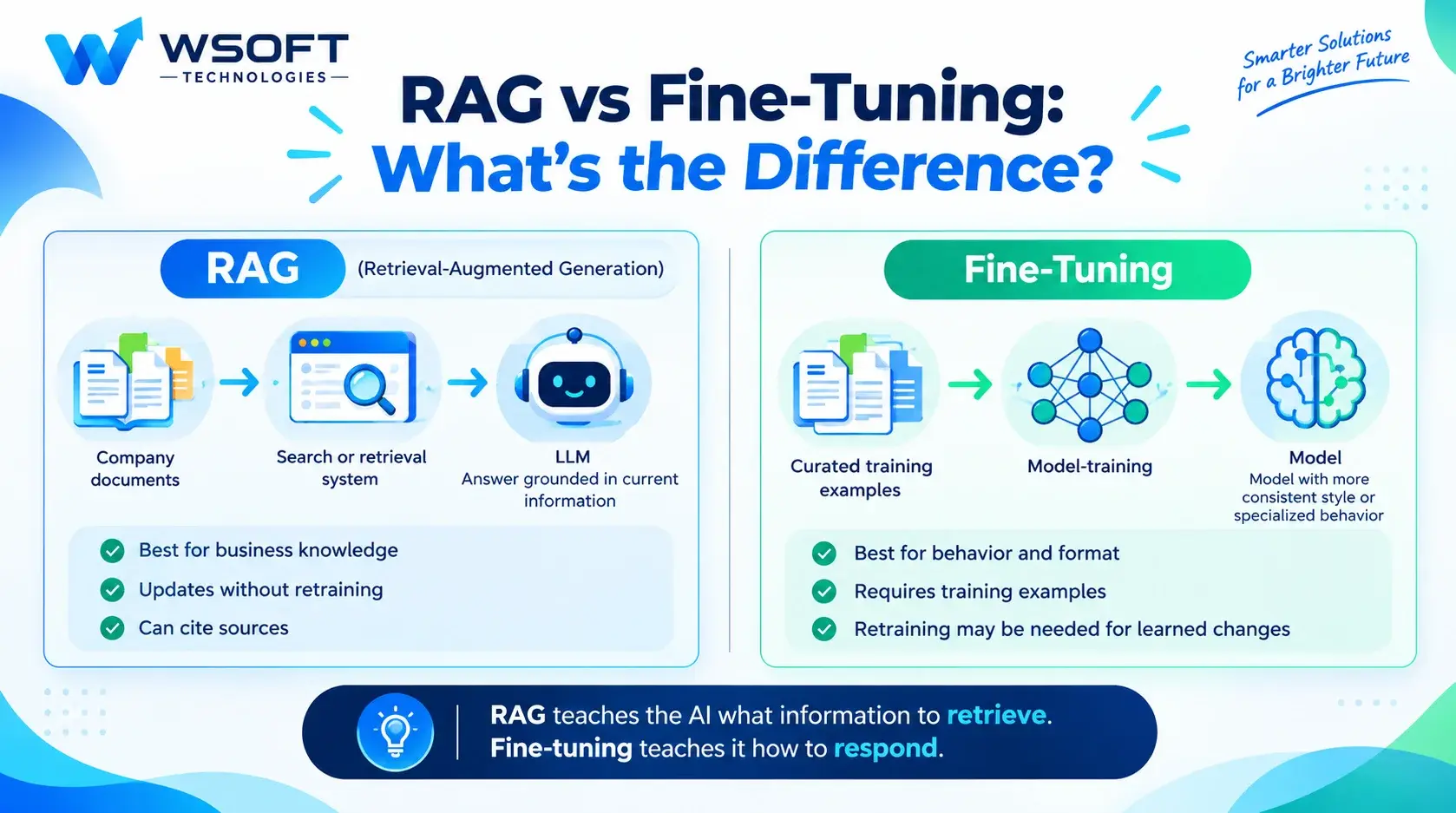
Businesses want AI systems that can answer questions about their products, policies, contracts, and internal data accurately. However, general-purpose language models do not automatically have access to your company's private information or the latest business documents.
Two common approaches can help: retrieval-augmented generation (RAG) and fine-tuning. Both improve how AI supports business needs, but they solve different problems.
In this blog, we explain RAG vs. fine-tuning, how each approach works, their key differences, and how to choose the right solution for your business data.
As a general rule, choose RAG when your AI needs to retrieve accurate, up-to-date information from company documents. Consider fine-tuning when you need to change a model's response style, output format, or performance on a specialised task. Some applications benefit from combining both approaches.
What Is RAG?
Retrieval-augmented generation (RAG) connects a large language model (LLM) to your own information sources. Instead of relying only on the knowledge learned during training, the system retrieves relevant information when a user asks a question.
For example, if an employee asks about your company's refund policy, a RAG-based assistant can search the approved policy documents and use the relevant information to generate an answer.
The model itself does not need to be retrained whenever a document changes. Instead, the underlying information source or search index is updated.
Benefits of RAG
- Up-to-date information: Answers can reflect changes to documents and policies when the retrieval system is properly maintained.
- Source references: The system can provide links or citations to the documents used to generate an answer.
- Lower initial investment: RAG can often be implemented without the cost of training a model on a custom dataset.
- Easier knowledge updates: Teams can update or remove source documents without retraining the language model.
- Better access to business information: Employees and customers can find relevant information across large document collections.
Limitations of RAG
- Answer quality depends on document quality and retrieval accuracy.
- Poorly organised or conflicting information can produce unreliable responses.
- The system requires ongoing maintenance of its search index and data sources.
- RAG does not automatically change the model's writing style or specialised behaviour.
RAG is particularly useful when a business needs an AI assistant that can answer questions using information that changes regularly.
What Is Fine-Tuning in AI?
Fine-tuning is a process in which an existing AI model is trained further on carefully selected examples to improve its behaviour for a specific task.
For example, a business might fine-tune a model to classify support tickets into predefined categories, produce consistently structured outputs, or follow a specialised writing style.
Unlike RAG, fine-tuning changes the model's learned parameters. It is generally used to improve how a model performs a task rather than to provide direct access to the latest company documents.
Benefits of Fine-Tuning
- Consistent responses: Helps the model follow a preferred tone, format, or response pattern.
- Specialised task performance: Can improve performance on narrow tasks when suitable training examples are available.
- Structured outputs: Can help the model produce consistent classifications or data formats.
- Potential efficiency gains: A suitably fine-tuned smaller model may handle a specialised task more efficiently than a larger general-purpose model.
Limitations of Fine-Tuning
- It requires high-quality training examples and a reliable evaluation process.
- Preparing data and training the model can increase initial costs.
- Updating learned behaviour or information may require additional training.
- It does not guarantee factual accuracy or eliminate hallucinations.
- It does not automatically provide access to live databases or current business documents.
One important distinction is that fine-tuning is usually better suited to teaching a model how to respond than ensuring it knows what is currently true about your business.
RAG vs. Fine-Tuning: Key Differences
RAG and fine-tuning serve different purposes. The right choice depends on whether your main challenge is accessing business information or improving model behaviour.
| Comparison | RAG | Fine-Tuning |
|---|---|---|
| Primary purpose | Provides access to external knowledge | Adapts model behaviour |
| Best suited for | Company documents and changing information | Specialised tasks, tone, and output formats |
| Updating information | Update the source documents or index | May require additional training if knowledge is encoded in the model |
| Source citations | Can provide references to retrieved documents | Does not provide source citations automatically |
| Initial setup | Requires data preparation and retrieval infrastructure | Requires training examples and a training process |
| Ongoing maintenance | Maintain documents, retrieval, and indexing | Evaluate performance and retrain when necessary |
| Common example | An assistant answering questions about company policies | A model classifying support tickets consistently |
Neither approach is universally better. RAG is often the more practical starting point for business knowledge assistants, while fine-tuning can be valuable when a model needs more consistent or specialised behaviour.
When Should You Choose RAG?
RAG is a strong choice when your AI system needs to answer questions using company information that changes over time.
Consider RAG if your business wants to:
- Build an AI assistant that searches internal documents, manuals, and policies.
- Provide customer support using current product information and approved help articles.
- Help employees find information across multiple business systems.
- Retrieve relevant contract clauses, technical documentation, or compliance policies.
- Update business knowledge without retraining the language model.
- Provide references that help users verify generated answers.
For example, a company with hundreds of frequently updated product manuals could use RAG to help its support team retrieve the correct information without manually searching through every document.
However, RAG still needs appropriate access controls, testing, and monitoring. Retrieving a relevant document does not guarantee that the final answer will be correct.
When Is Fine-Tuning Worth It?
Fine-tuning is worth considering when you have a clearly defined task that prompting alone does not handle consistently.
It may be suitable when:
- You need the model to follow a specific writing style or output format at scale.
- You need consistent classification or information extraction from large volumes of input.
- Your application relies on specialised terminology or repeated task patterns.
- You have enough high-quality examples to train and evaluate the model.
- Testing shows that fine-tuning improves performance or operating efficiency.
For instance, a business processing thousands of support tickets could fine-tune a model to categorise requests into predefined groups.
Before investing in fine-tuning, establish a baseline and test whether better prompts, improved examples, or a RAG implementation can solve the problem more simply.
How to Connect an LLM to Company Documents Using RAG
If your business needs an AI assistant that answers questions from internal documents, RAG provides a practical way to connect a language model to that information.
Here is how the process typically works.
Collect and Prepare Your Data
Gather the documents your AI assistant needs, such as PDFs, knowledge base articles, product manuals, internal policies, and approved database records.
Remove duplicate files, replace outdated documents, and check for conflicting information before importing the content.
Split Documents into Smaller Sections
Large documents are usually divided into smaller sections called chunks. Each chunk should contain enough context to preserve its meaning while remaining focused enough to retrieve accurately.
The appropriate chunk size depends on the document type, search method, and intended use case.
Create Embeddings
Embeddings convert text into numerical representations that help a system identify semantically related information.
For example, a user asking about cancelling an order may need a document section titled "Order Cancellation Policy," even if the wording does not match exactly.
Store the Content in a Searchable Index
The chunks and their embeddings can be stored in a vector database or another suitable search system.
Depending on the application, the system may also use keyword search or hybrid search to improve retrieval accuracy.
Retrieve Relevant Information and Generate an Answer
When a user asks a question, the system searches for relevant document sections and supplies them to the language model along with the question and instructions.
The model then generates a response using the retrieved information.
Apply Security and Access Controls
Ensure users can access only the documents and information they are authorised to see.
Permissions should be enforced during retrieval, not just after the answer has been generated. Sensitive information should also be handled according to your business's privacy and security requirements.
Test and Monitor Performance
Test the system using realistic questions and verify whether it retrieves the correct documents and produces accurate answers.
Monitor retrieval quality, answer accuracy, response time, and failure cases. Update the source content and retrieval configuration as your business requirements change.
A reliable RAG system depends on the quality of the entire pipeline, including document preparation, retrieval, permissions, and answer generation.
Is an AI Chatbot Trained on Company Data Really Trained?
When businesses ask for an AI chatbot trained on company data, they often mean a chatbot that can answer questions using their internal information.
In many cases, RAG is the appropriate solution. The model remains the same, but the application retrieves relevant company information whenever a question is asked.
Fine-tuning is different because it uses training examples to adjust the model's parameters. However, even a fine-tuned model should not be treated as a guaranteed source of current company facts.
RAG can make knowledge easier to update and remove from the retrieval system, although copies may remain in caches, logs, or other storage unless those are managed too. Fine-tuning can be harder to reverse because information may influence the model's learned parameters.
Neither approach automatically guarantees data privacy. Both require appropriate security controls, data governance, and careful selection of the services being used.
Enterprise RAG Use Cases
RAG can support many business workflows where people need reliable access to information spread across large document collections.
Internal Knowledge Assistants
Employees can ask questions about HR policies, IT procedures, internal guidelines, and project documentation instead of searching through multiple systems manually.
Customer Support Automation
An AI support assistant can retrieve approved help articles, product documentation, and service policies to answer common customer questions. Complex cases can be escalated to a human representative.
Sales Enablement
Sales teams can quickly find product specifications, pricing guidelines, approved sales materials, and relevant case studies.
Legal and Compliance Research
Teams can search contracts, internal policies, and regulatory documents. Source references help users verify the relevant information, although legal decisions still require appropriate professional review.
Technical Documentation Search
Developers and technical teams can ask questions about API documentation, system architecture, troubleshooting guides, and internal engineering procedures.
Employee Onboarding
New employees can use an internal AI assistant to find answers about company processes, tools, and workplace policies.
For each use case, access controls and evaluation should be designed around the sensitivity and importance of the information involved.
Common RAG and Fine-Tuning Mistakes to Avoid
Choosing the right AI approach is only part of the process. Avoid these common mistakes when developing a business AI solution.
- Using fine-tuning to solve every knowledge problem: Start with RAG when the main requirement is access to current company information.
- Ignoring data quality: Outdated, duplicate, or conflicting documents can reduce answer quality.
- Skipping evaluation: Test retrieval and generated answers against realistic questions before deployment.
- Ignoring access permissions: Ensure the system respects document-level and user-level permissions.
- Assuming RAG eliminates hallucinations: Instruct the model to acknowledge missing information and test its responses carefully.
- Treating deployment as the final step: Review performance regularly and update documents, prompts, and retrieval settings when needed.
- Fine-tuning without a clear objective: Define measurable performance goals before investing in training.
A structured development process helps businesses avoid unnecessary complexity and focus on improvements that deliver measurable value.
A Simple Decision Guide: RAG, Fine-Tuning, or Both?
Use the following guidelines to select an approach based on your business requirements.
Choose RAG if:
- Your AI needs to answer questions using company documents.
- Your information changes frequently.
- You want answers supported by document references.
- You need to control which users can access specific information.
Consider fine-tuning if:
- Your model needs a consistent tone or output format.
- You need better performance on a specialised, repeated task.
- Prompting and other simpler approaches have not met your quality targets.
- You have suitable training data and a reliable evaluation method.
Consider combining RAG and fine-tuning if:
- Your AI needs both current business knowledge and specialised behaviour.
- RAG provides the relevant facts, while fine-tuning improves how the model processes or presents them.
- Testing demonstrates that the additional complexity is worth the cost.
For many business applications, starting with RAG and adding fine-tuning only when needed is a sensible approach. The final decision should be based on testing, data requirements, security, and total operating cost.
Frequently Asked Questions
Is RAG Better Than Fine-Tuning?
RAG is generally better for accessing current company information, while fine-tuning is useful for adapting model behaviour. The right choice depends on your requirements.
Can RAG and Fine-Tuning Be Used Together?
Yes. RAG can supply current business information, while fine-tuning can help the model follow specialised response patterns or formats.
Does RAG Train an AI Model?
No. RAG retrieves relevant information when you ask a question and provides it to the model. It does not inherently retrain the model.
How Much Does It Cost to Build a RAG System?
Costs depend on data volume, integrations, model usage, security requirements, infrastructure, and testing. A project estimate requires a clear understanding of the scope.
Is RAG Secure for Business Data?
RAG can support secure business applications when you implement access controls, data protection, and monitoring correctly. Security depends on the complete system design.
Final Thoughts
Choosing between RAG and fine-tuning starts with understanding what your business needs from AI. If the main goal is to answer questions using current company documents, RAG is often the most practical starting point. If you need specialised behaviour, consistent formatting, or improved performance on a specific task, fine-tuning may be worth evaluating.
You do not need to build a language model from scratch to create a useful business AI solution. A well-designed system can combine an existing model with reliable data retrieval, appropriate security controls, and continuous evaluation.
At Wsoft Technologies, we help businesses explore custom AI solutions based on their workflows, data, and technical requirements. Planning an AI solution for your business? Start a project with Wsoft Technologies to discuss your use case and identify an approach that fits your goals.
Have a project in mind?
Talk to the Wsoft Technologies team by phone or WhatsApp.